Most email accounts fail not because of how they are used, but because of how they were created. A registration shortcut, an unverified phone number, a suspicious IP address during sign-up - any one of these can doom an account before it sends its first message. For professionals who depend on email infrastructure at scale, this is not a theoretical risk. It is a recurring operational problem with real costs.
Hotmail, now integrated into Microsoft's broader Outlook ecosystem, remains one of the most widely accepted email platforms across business tools, SaaS applications, and communication networks. The accounts carry trust precisely because Microsoft's verification standards are high - which also makes them difficult to register in volume through standard self-service methods. Professionals who need reliable, ready-to-use accounts increasingly turn to specialized providers for this reason. If you need to buy verified Hotmail accounts without the friction of manual registration loops, services like buy verified hotmail accounts provide a curated catalog that addresses this exact need.
This article covers the full process: what distinguishes a genuinely verified account from a substandard one, why professional demand for these accounts exists, how to identify trustworthy providers, how to execute a purchase safely, and how to maintain accounts once you have them. Every section is built around practical, actionable guidance for readers who already understand the basics and need real answers.
Understanding Genuine and Verified Hotmail Accounts
The word "verified" is used loosely in this market, which creates real confusion for buyers. In precise terms, a verified Hotmail account is one that has completed Microsoft's identity confirmation requirements during registration - most commonly through a phone number capable of receiving an SMS code, or through a secondary email address used as a recovery contact. This verification step is not cosmetic. It unlocks full account functionality and signals to Microsoft's trust systems that the account belongs to a real, reachable person.
Authentic Microsoft email accounts that have passed phone verification carry a meaningfully higher trust score within Microsoft's internal systems than those verified only by secondary email. This distinction matters for deliverability, feature access, and resistance to automated security challenges. An account without proper verification is frequently subject to immediate activity restrictions, CAPTCHA walls during login, and accelerated flagging when used for any non-trivial purpose.
There is also a meaningful difference between accounts registered manually - by a real person following the standard sign-up flow - and those produced through automated bulk registration tools. Manually registered accounts accumulate behavioral signals that automated ones cannot replicate: varied interaction patterns, realistic session lengths, and IP histories that do not trigger Microsoft's anomaly detection. When you look to purchase genuine Hotmail accounts, this distinction between manual and automated registration should be one of the first questions you ask any provider.
Account age adds another layer of value. An account registered weeks or months before purchase has already passed Microsoft's initial monitoring window and has established a baseline of normal behavior. Fresh accounts, registered immediately before sale, have not yet accumulated that history. Both have legitimate uses, but they serve different purposes depending on the application.
- Phone-verified accounts: highest trust score, full feature access, best for outreach and platform registration
- Secondary email-verified accounts: moderate trust level, suitable for testing and light communication use
- Fresh accounts: newly registered, no usage history, appropriate for development and controlled testing
- Aged accounts: established registration history, better deliverability and platform acceptance rates
- Accounts with profile setup: name, recovery options, and avatar configured, reducing early security flags
- Region-specific accounts: registered via IPs matching a specific country, useful for geo-targeted operations
Why Businesses and Professionals Seek Hotmail Account Registration Services
The demand for Hotmail account registration services is not driven by frivolous convenience. It emerges from practical constraints that anyone who has attempted large-scale manual registration will recognize immediately. Microsoft's security infrastructure is built to detect and block patterns that resemble bulk account creation: repeated registrations from the same IP address, similar browser fingerprints, sequential phone numbers, and timing anomalies during sign-up. These defenses are effective, which means legitimate professionals who need multiple accounts for entirely valid reasons face the same barriers as bad actors.
Digital marketers managing campaigns across multiple client accounts need separate email identities that do not cross-contaminate sending reputations. Software developers building and testing Microsoft-integrated applications require dedicated accounts they can manipulate, reset, or delete without affecting live systems. Businesses expanding into new regions may need locally registered accounts to establish communication credibility with regional platforms that validate sender origins.
Time is also a factor that is easy to underestimate. A single manual Hotmail registration, done properly - with a unique IP, a real phone number, a plausible profile, and appropriate wait times between steps - takes considerably longer than the few minutes the sign-up page suggests. Multiply that across dozens of accounts, and the labor cost becomes significant. Professional registration services exist to absorb that overhead and deliver accounts that are ready to use from the moment credentials are handed over.
| User Type | Primary Need | Most Important Account Feature |
|---|---|---|
| Digital Marketer | Separate identities for multi-client campaign management | Clean sending reputation, phone-verified status |
| Software Developer | Isolated accounts for Microsoft API testing | Full feature access, stable login credentials |
| Business Owner | Regionally registered accounts for local credibility | Region-matched IP registration, aged account history |
| Affiliate Marketer | Platform registrations and outreach in volume | Fresh, phone-verified accounts in consistent batches |
| Security Researcher | Controlled, isolated environments for testing | Independently verified, non-linked accounts |
How to Evaluate Verified Email Account Providers
The range of quality among verified email account providers is wide enough that two providers offering the same product description may deliver entirely different outcomes. Understanding how to read a provider's reliability before purchase is the difference between a smooth operational setup and a frustrating cycle of failed accounts and disputed refunds.
Key Quality Indicators to Look For
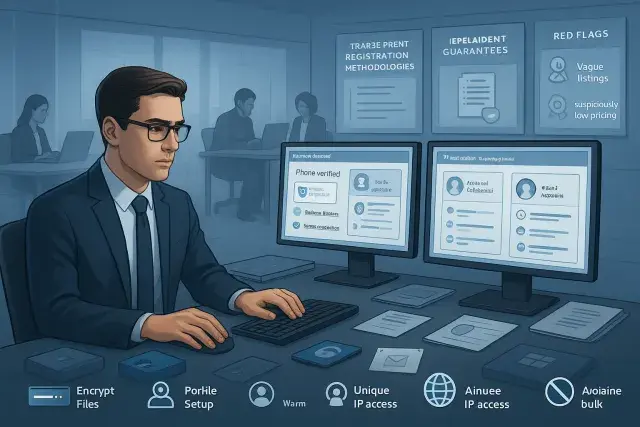
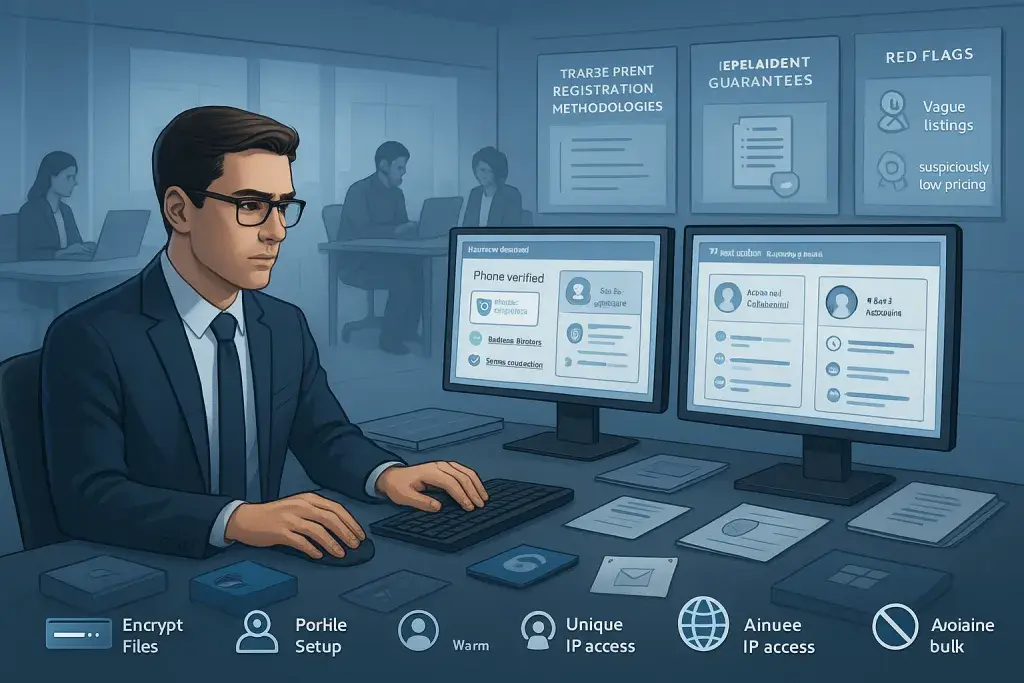
Reliable providers are transparent about their process. They explain, at least at a general level, how accounts are created - whether through supervised manual registration, specific IP configurations, or dedicated phone number pools - because they have nothing to hide about their methods. This transparency is itself a signal of quality. Providers who describe their process vaguely or deflect questions about registration methodology are frequently reselling low-quality bulk accounts they did not create themselves.
Account specifications should be detailed and specific. A trustworthy listing will tell you the verification method used, the account's age at time of sale, the region of registration, what credentials are included, and what format they will be delivered in. Listings that simply say "Hotmail account available" without further detail are a reliable indicator of vague quality standards.
Post-sale policy is equally revealing. Providers confident in their accounts offer clear replacement guarantees for non-functioning credentials, typically within a defined window after delivery. This warranty structure only makes commercial sense if the provider is consistently delivering accounts that work. Sellers with no stated policy on account failures are effectively communicating that they expect failures to occur and prefer not to be accountable for them.
- Transparent explanation of account registration method
- Detailed account specifications per listing (verification type, age, region)
- Clear replacement or refund policy for non-functioning accounts
- Verifiable customer reviews or transaction history on the platform
- Accessible support channel with demonstrably responsive handling
- Secure credential delivery format (encrypted file or protected transfer)
Red Flags That Signal Unreliable Providers
Price is a useful but imprecise filter. Accounts priced dramatically below market rates are almost always problematic - either bulk-generated by automated tools, recycled from previous buyers, or registered under conditions that Microsoft has already flagged. The cost of creating a properly verified, manually registered account is not trivial, and pricing that ignores this reality suggests the provider is cutting corners somewhere significant.
Ambiguous product listings are another warning sign. If a seller cannot specify whether an account is phone-verified or email-verified, whether it is fresh or aged, or what recovery information is attached to it, that vagueness is not accidental. It typically means the provider does not know these details because they did not control the registration process.
Providers who are inaccessible before purchase - no support chat, no response to pre-sale questions, no visible contact method - should be avoided regardless of how attractive their listings appear. The time to assess a provider's responsiveness is before you need them to resolve an issue, not after an account fails to work.
- Pricing significantly below comparable offerings with no quality justification
- Missing or vague account specifications in product listings
- No stated policy for non-functioning or expired accounts
- Seller has no verifiable transaction history or review record
- Credentials delivered in unencrypted plain text via unsecured channels
- No pre-sale support channel or consistently unresponsive communication
Comparing Provider Types: Marketplaces vs. Dedicated Services
When looking to acquire verified email addresses from a professional source, buyers typically encounter two distinct provider models, each with structural advantages and limitations.
General account marketplaces aggregate listings from multiple independent sellers under one platform. The variety of account types, regions, and price points is typically broader, but quality consistency varies by seller. A marketplace with strong seller vetting and a robust dispute resolution system can mitigate this risk substantially, but buyers must still evaluate individual sellers within the platform rather than treating the marketplace itself as a uniform quality guarantee.
Dedicated registration services control the entire account creation process internally. They register accounts themselves, verify them through their own channels, and deliver a consistent product. The trade-off is that variety may be narrower - fewer region options, fewer account types - but the quality baseline tends to be higher and more predictable. For professional buyers with recurring needs and low tolerance for account failures, dedicated services typically deliver better long-term value.
| Provider Type | Quality Consistency | Product Variety | Support Structure | Best Suited For |
|---|---|---|---|---|
| General Marketplace | Variable by seller | High | Seller-dependent | Exploratory buyers, low-volume purchases |
| Dedicated Registration Service | Consistently high | Moderate | Centralized and reliable | Professional and business buyers |
| Vetted Catalog Platform | High with seller standards | High | Platform-level oversight | Scalable and recurring procurement needs |
Step-by-Step Process for Purchasing Genuine Hotmail Accounts Safely
Knowing which provider to choose is only part of the equation. How you execute the purchase - and what you do in the immediate aftermath - has a direct impact on whether the accounts perform as expected or encounter problems within hours of first use.
Preparing Your Requirements Before You Buy
Entering a purchase without clear specifications is one of the most common and avoidable mistakes buyers make. Providers offer multiple account types, and selecting the wrong one for your use case means getting accounts that technically function but do not meet your operational requirements.
Before you contact any provider or place any order, define your requirements in concrete terms. The answers to these questions should shape every purchasing decision you make.
- Determine the exact quantity of accounts needed, including a reasonable buffer for potential failures
- Specify the required verification type - phone-verified accounts for high-trust applications, email-verified for lower-stakes use cases
- Identify whether regional registration matters for your use case and, if so, which region
- Decide whether aged accounts are necessary or whether fresh accounts are sufficient
- Set a budget that reflects realistic quality expectations rather than the lowest available price
- Prepare a secure credential storage system - a dedicated password manager or encrypted file - before accounts arrive
Completing the Purchase and Verifying Account Delivery
Use a payment method that offers transaction traceability and buyer protection where available. Reputable providers accept established payment options and issue clear order confirmations that document what you purchased and under what terms.
Upon delivery, your first action should be verification - not storage, not deployment. Log into each account immediately, confirm that the credentials match the specifications you were promised, and check for any restriction notices, pending verification prompts, or security alerts within the account dashboard. Most replacement warranties operate within a short post-delivery window, and accounts that fail outside this window are typically considered accepted.
- Confirm that payment method offers transaction traceability
- Review the order summary against the listing specifications before completing checkout
- Log into each delivered account within hours of receipt to confirm access
- Check for login errors, Microsoft security alerts, or any restricted access flags
- Test basic functionality - sending a test message, accessing account settings - to confirm full feature availability
- Document any account failures with screenshots and timestamps before contacting provider support
Best Practices for Account Activation and First Use
The period immediately after a new account is accessed for the first time is when Microsoft's monitoring is most active. Accounts that exhibit sudden high-volume behavior - sending dozens of emails, registering across multiple platforms simultaneously, or logging in from multiple IP addresses within the same session - are flagged and often restricted before they can be used effectively.
A measured activation approach protects your investment. Log into each account individually, allow brief intervals between sessions, and complete any profile setup steps before initiating active sending or platform registration. This includes adding a display name, confirming recovery options where possible, and familiarizing the account with normal browsing patterns across a day or two before scaling activity.
- Access accounts individually rather than logging into all of them simultaneously
- Allow short intervals between account activations to avoid pattern detection
- Use dedicated proxies or unique IP addresses for each account during initial activation
- Complete profile setup - display name, recovery options - before starting active use
- Increase sending volume gradually over the first week rather than starting at full scale
- Avoid triggering Microsoft's security review by keeping initial activity patterns conservative and varied
Legal and Ethical Considerations When Acquiring Verified Email Accounts
This topic warrants honest treatment rather than either dismissal or exaggeration. Purchasing pre-registered email accounts occupies a space where platform terms of service, legal frameworks, and practical professional use do not always align neatly. Understanding the actual boundaries - rather than assuming the practice is either entirely problem-free or entirely prohibited - is important for anyone making this type of procurement decision.
Microsoft's terms of service are primarily concerned with how accounts are used. Accounts deployed for spam distribution, phishing, coordinated inauthentic behavior, or fraud are clearly prohibited and carry real legal risk in many jurisdictions. The fact that an account was purchased rather than self-registered does not make these uses legitimate. Conversely, purchasing accounts for legitimate professional purposes - application testing, managed communication workflows, business identity management - does not by itself constitute a terms violation, though the boundary between permitted and restricted use depends on specific application.
The ethical dimension centers on the integrity of the accounts themselves. Accounts that were genuinely registered through proper processes, even if subsequently sold, carry different implications than accounts created fraudulently or through deceptive registration methods. Choosing providers who produce authentic accounts through legitimate registration processes - rather than those who manufacture artificial identities through automated exploitation - is both an ethical choice and a practical one, since authentic accounts are far more stable and far less likely to create downstream problems.
- Review Microsoft's acceptable use policy as it applies to your specific use case before purchasing
- Ensure purchased accounts were created through genuine registration processes, not automated fraud tools
- Avoid any use case involving spam, deceptive communication, or coordinated inauthentic behavior
- Choose providers who explicitly describe their registration methodology and promote legitimate use
- Understand that terms of service violations and legal liability are determined by how accounts are used, not merely by the purchase itself
Maximizing the Value of Your Purchased Hotmail Accounts
The quality of the accounts you buy sets a ceiling on performance. How you manage them determines whether you reach that ceiling or fall short of it. Premature account loss is rarely caused by poor account quality alone - it is almost always a combination of quality issues and preventable management failures.
Account Security and Credential Management
Immediately after confirming that a purchased account is functional, update the access password to one you control exclusively and add your own recovery contact information where the account settings allow. This step is not optional. Accounts whose credentials have not been changed after purchase carry the risk that the original registrant - or the provider - retains access, which is an unacceptable security exposure for any professional use case.
Store all account credentials in a dedicated password manager or encrypted credential file, never in plain text documents or shared drives. Two-factor authentication should be enabled where your workflow permits it, as it significantly raises the barrier against unauthorized access. Accounts that go unused for extended periods are subject to Microsoft's inactivity policies, which can result in suspension or permanent deletion. If you are maintaining a pool of accounts not in constant use, schedule periodic light activity - a login session, a draft saved - to keep each account within active status thresholds.
Scaling Your Account Portfolio Strategically
Buyers with ongoing or growing needs benefit significantly from treating their account procurement as a managed process rather than a series of one-off transactions. Establishing a consistent relationship with a reliable provider allows you to negotiate on volume, maintain quality standards across purchases, and build familiarity with the provider's account types and delivery timelines.
A rotation strategy - distributing activity across multiple accounts rather than concentrating it on a few - reduces the risk that any single account failure disrupts your operations. Track account performance over time: note which accounts maintain clean sending scores, which encounter friction during platform registration, and which degrade faster than expected. This performance data is valuable input for future purchasing decisions and for identifying whether a provider's quality has shifted over time.
| Management Area | Recommended Action | Timing |
|---|---|---|
| Credential Security | Change password and update recovery contact information | Immediately upon receipt |
| Account Verification | Test login access and full feature availability | Within hours of delivery |
| Initial Activation | Complete profile setup before starting active use | First session after login |
| Activity Warm-Up | Gradually increase sending volume over initial period | First seven to fourteen days |
| Dormancy Prevention | Periodic light usage to maintain active status | Monthly for inactive accounts |
| Portfolio Review | Assess account performance and refresh failing accounts | Quarterly |
Questions and Answers
What is the practical difference between a phone-verified and an email-verified Hotmail account for professional use?
Phone-verified accounts receive a higher trust score within Microsoft's systems because phone numbers are harder to obtain in bulk and carry a stronger identity signal than secondary email addresses. For outreach, platform registration, or any use case where deliverability and account stability matter, phone-verified accounts are the more reliable choice. Email-verified accounts are adequate for controlled testing environments where the stakes are lower.
How quickly should I test accounts after receiving credentials from a provider?
Test every account within hours of receiving credentials, not days. Most provider replacement warranties are time-limited, and the window to claim a non-functioning account is typically short. Waiting until you need the accounts in production before testing them leaves you with no recourse if credentials are invalid or accounts are already restricted.
Can I use multiple purchased accounts from the same IP address without triggering Microsoft's security systems?
Using multiple accounts from the same IP address simultaneously is one of the most reliable ways to trigger Microsoft's security detection, particularly for newly acquired accounts. Each account should be accessed from a unique IP, either through dedicated proxies or separate network connections, especially during the initial activation and warm-up period. After accounts are established, some consolidation is possible, but caution during the early phase is essential.
What should I do if a provider refuses to replace a non-functioning account within the warranty period?
Document the failure thoroughly before contacting support - include screenshots of the login error, the account identifier, and the timestamp of first access attempt. Present this documentation in your support request. If the provider refuses despite clear evidence and a valid warranty claim, initiate a dispute through your payment provider and consider this a signal to source future accounts elsewhere. A provider's handling of failure claims reveals more about their reliability than their marketing does.
Are aged Hotmail accounts always better than fresh ones, or does it depend on the use case?
Aged accounts are preferable for use cases where platform trust and deliverability matter - email outreach, account registration on platforms that apply reputation filters, and any application where Microsoft's internal account scoring affects outcomes. Fresh accounts are entirely adequate for development testing, controlled research environments, or short-term use where account longevity is not a priority. Paying a premium for aged accounts when your use case does not require them is unnecessary.
How many accounts is it realistic to manage effectively without dedicated tooling?
Without dedicated account management tools, most individuals can effectively maintain between ten and twenty accounts before credential confusion, activity tracking gaps, and rotation errors start causing problems. Beyond that threshold, a password manager with organized tagging, a simple spreadsheet tracking account status and last-use dates, or a lightweight inbox management tool becomes a practical necessity rather than an optional convenience.