A gaming account with years of progress and rare inventory can sell for more than a month's rent in many cities. That single fact tells you everything about how seriously people take the market for virtual accounts and digital goods - and how much is at stake when a transaction goes wrong. This space has grown from a niche hobby into a mature, high-volume economy where buyers and sellers exchange real money for intangible assets every minute of every day. Yet for all its scale, the market remains poorly understood by most of the people participating in it.
The risks are not theoretical. Buyers lose money to sellers who reclaim accounts hours after a sale. Sellers lose goods to fraudulent chargebacks. Both sides sometimes choose the wrong platform and discover, too late, that there is no dispute process to protect them. Knowing how account trading works - what makes a transaction safe, what makes it dangerous, and where to find reliable infrastructure - is not optional knowledge. It is the difference between a smooth deal and a total loss. Dedicated platforms like an accs shop exist precisely because informal channels carry too much risk for consistent, professional-grade transactions.
This guide covers the full picture: what the digital goods market actually involves, how legitimate online marketplaces operate, the legal context you cannot afford to ignore, step-by-step safety practices for both buyers and sellers, and the fraud patterns that claim victims most often. Whether you are making your first purchase or building a long-term account selling operation, what follows is the practical foundation you need.
Understanding the Digital Goods and Virtual Account Market
The term "digital goods" covers a wider range of products than most people initially assume. At one end of the spectrum are simple items: a software activation key, a gift card code, or a downloadable file. At the other end are complex assets with layered value: a social media profile with an established audience, a gaming account carrying years of unlocked content, or an aged email account with a clean sending history. Virtual accounts occupy their own distinct category because what you are buying is not just access credentials - you are acquiring the account's history, attributes, and standing within a given platform's ecosystem.
Demand for these products is driven by a straightforward logic: building from scratch takes time, and time has a price. An advertiser who needs a social account with a credible posting history can acquire one in minutes rather than months. A competitive gamer who wants a character with rare gear can purchase an account rather than grinding for hundreds of hours. Businesses use aged email accounts for outreach because fresh accounts trigger spam filters. Each use case reflects a rational calculation about value, and that rationality is what makes this market durable.
The supply side is equally varied. Some sellers are individuals offloading accounts they no longer use. Others are dedicated traders who buy accounts in bulk, maintain them, and resell at a margin. Software developers sell surplus license keys. The common thread is that all of them are offering something with a defined value to a buyer who wants it - which is the basic definition of a functioning market.
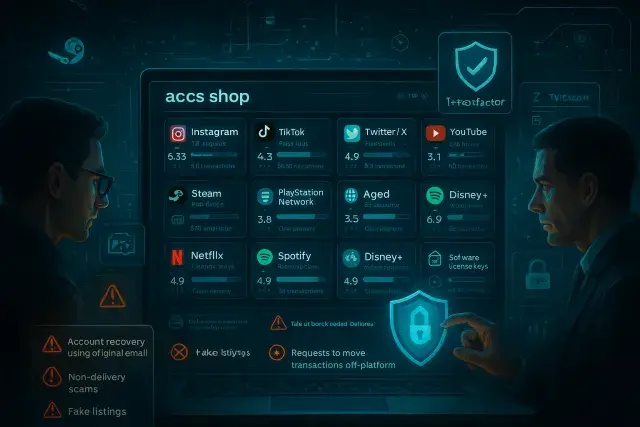
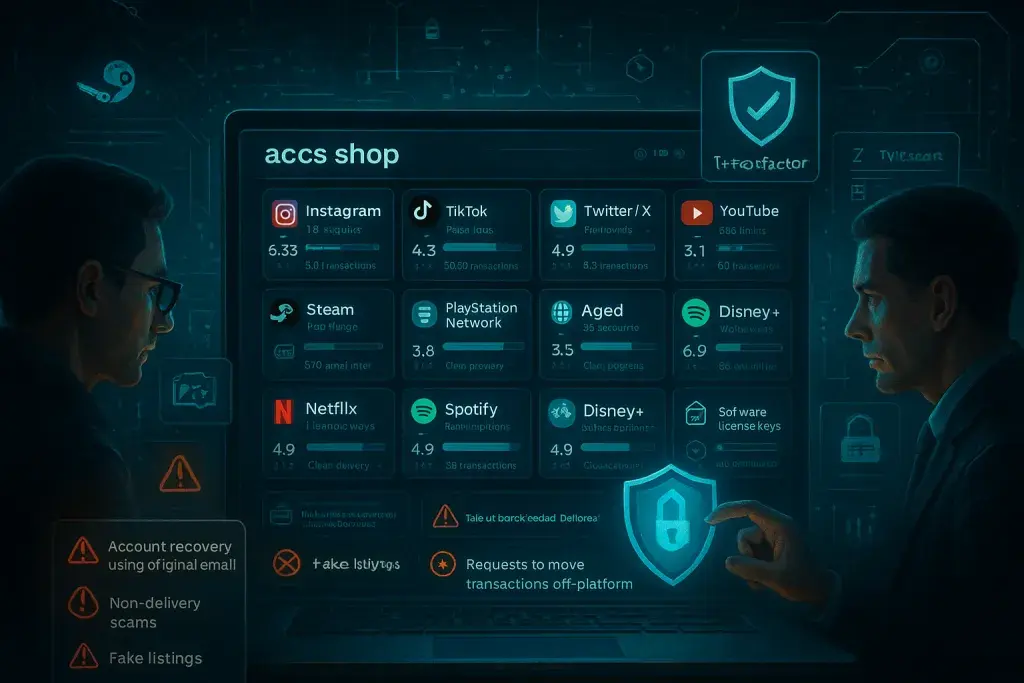
- Social media accounts on platforms such as Instagram, TikTok, Twitter/X, and YouTube
- Gaming accounts on Steam, PlayStation Network, Xbox, or specific titles with in-game progress
- Streaming service subscriptions including Netflix, Spotify, and Disney+
- Software license keys and activation codes
- Aged email accounts with clean delivery histories
- Cryptocurrency exchange accounts with verified identity status
- SaaS and productivity tool subscriptions
Understanding the breadth of this market matters because safety practices vary by category. The risks associated with buying a game key differ substantially from those involved in acquiring a verified financial account. Treating every digital goods transaction as interchangeable leads to both overpaying for protection you don't need and underestimating risks you should take seriously.
How Online Marketplaces for Account Trading Work
The infrastructure behind account trading ranges from highly sophisticated to dangerously informal. A dedicated online marketplace built for digital goods will have systems, policies, and staff specifically designed to handle the unique challenges of these transactions. A Telegram group or a classified ad forum will have none of that. Knowing the difference - and choosing accordingly - is one of the most consequential decisions a buyer or seller can make.
Types of Platforms Used for Account Trading
Purpose-built digital marketplaces are the gold standard for account trading. They offer structured transaction flows, identity verification for sellers, escrow or payment-hold systems, and formal dispute resolution processes. These platforms make money when transactions succeed, which aligns their incentives with both buyers and sellers. General classifieds sites are designed for physical goods and lack the infrastructure to handle the specific problems that arise in virtual account sales. Social media groups and forums operate on reputation and community trust alone, which provides some protection but no formal recourse.
| Platform Type | Buyer Protection | Seller Verification | Dispute Resolution | Risk Level |
|---|---|---|---|---|
| Dedicated digital marketplace | High - built-in escrow or protection policy | Formal identity or seller verification | Dedicated support team | Low to moderate |
| Gaming forums and trading boards | Community-based reputation only | Vouches and transaction history | Moderator intervention, limited | Moderate |
| General classifieds sites | None | None | None | High |
| Social media groups and messaging apps | None | None | None | Very high |
The Role of Escrow and Payment Protection
Escrow solves the oldest problem in trade: who moves first. In a standard escrow arrangement, the buyer sends payment to a neutral third party - typically the platform itself - which holds the funds until the buyer confirms receipt and satisfaction with the product. Only then are the funds released to the seller. This eliminates the binary choice between blind trust and paralysis that makes peer-to-peer transactions so risky.
Not all escrow systems are equally robust. Some platforms release funds automatically after a fixed time window, which can disadvantage buyers who need time to verify a complex account. Others require explicit buyer confirmation, which creates leverage for dishonest buyers to delay payment indefinitely. Understanding which model a platform uses before committing to a transaction is worth a few minutes of research.
Payment method selection adds another layer. Credit card transactions carry chargeback rights that provide meaningful recourse when things go wrong. Platform-native wallets on established marketplaces often include their own buyer guarantees. Cryptocurrency transactions are irreversible by design - once sent, funds cannot be recalled - which makes them appropriate only when the marketplace itself holds them in escrow on the buyer's behalf. Direct wire transfers and informal payment apps offer essentially no protection and should not be used for account trading between strangers.
Seller Reputation and Rating Systems
Reputation systems are the backbone of trust on digital marketplaces. A seller's rating, review history, total completed transactions, and response rate collectively paint a picture of reliability that no single data point can capture alone. A seller with a 4.9-star average across fifty transactions tells a very different story than one with the same average across three. Volume matters as much as score.
Reading reviews critically is a skill in itself. Look at negative reviews as closely as positive ones - the seller's response to a complaint often reveals more about their professionalism than the complaint itself. Watch for patterns: a cluster of negative reviews about account recovery, for example, is a specific and serious warning sign. Check the dates of reviews to ensure activity is recent, not just historical.
Verification badges, where platforms offer them, indicate that a seller has passed some form of identity or credential check. They are not a guarantee of honest behavior, but they do mean that the seller is accountable in a way that an anonymous account is not. Always weigh verification status alongside transaction history rather than treating either as sufficient on its own.
Legal and Terms-of-Service Considerations
The legal landscape surrounding virtual account sales is genuinely complex, and conflating two distinct issues - platform policy and national law - leads to bad decisions. Most platforms whose accounts are commonly traded have terms of service that prohibit transfers or sales. Violating those terms can result in account termination. That consequence is real and worth considering. But it is a contractual matter between the account holder and the platform, not a criminal one in most jurisdictions.
Platform Terms of Service vs. Legal Legality
When a user agrees to a platform's terms of service, they typically agree that the account is non-transferable and that the credentials cannot be sold. Breaking that agreement gives the platform grounds to suspend or permanently ban the account. This is the primary operational risk in account trading: the asset you just purchased can be deactivated by a third party who was never part of your transaction.
Legal liability under national law is a different question. Selling an account you legitimately created and used is, in most countries, not a criminal act. It may create civil complications in rare cases, but the typical individual buying or selling a social media or gaming account is not at meaningful legal risk from law enforcement. The practical risk is the platform enforcement risk, not a courtroom risk.
The situation changes sharply when accounts were obtained illegally. Accounts acquired through credential stuffing, phishing, hacking, or unauthorized access represent stolen property. Selling or knowingly buying such accounts carries genuine legal exposure in most jurisdictions, including potential charges related to fraud, receiving stolen goods, or computer crime statutes. The distinction between a legitimately created account and a compromised one is not always obvious from a listing - which is exactly why seller verification and platform vetting matter so much.
- Read the terms of service for the originating platform before any transaction
- Confirm that the account was created by the seller, not acquired through third-party breach
- Be aware that platform bans can occur without warning even on legitimately transferred accounts
- Understand that legal risk scales with the nature of the account - financial accounts carry far higher exposure than gaming profiles
What Makes an Account Sale Legally or Ethically Problematic
Certain account types warrant heightened caution regardless of how the transaction is structured. Accounts tied to financial services, identity verification, or government platforms carry regulatory implications that ordinary consumer accounts do not. Selling access to accounts with stored payment information, even indirectly, can constitute fraud. Accounts created by one person but registered under another person's identity represent identity fraud on their face.
Ethical problems can exist even where legal liability is minimal. Selling an account with fabricated metrics - inflated follower counts, purchased engagement, or false verification status - harms the buyer and, in many cases, the downstream audiences or businesses that interact with that account. Misrepresentation of this kind is both unethical and a reliable way to generate disputes, negative reviews, and potential platform bans.
How to Buy Virtual Accounts and Digital Goods Safely
Buying on a digital marketplace requires a different kind of due diligence than buying physical products. You cannot hold the item, inspect it, or return it to a physical location. What you can do is gather enough verified information before payment to make an informed decision - and structure the transaction in a way that protects you if something goes wrong after.
Evaluating Sellers Before You Buy
Seller evaluation is not a single check - it is a layered process. Start with the quantitative signals: total completed sales, rating score, and account age on the platform. These numbers give you a baseline. Then move to qualitative signals: read the actual text of reviews, particularly any negative ones, and examine how recently they were written. A seller who was active and well-reviewed two years ago but has no recent activity is an unknown quantity.
Communication behavior is a revealing signal. Reach out with a specific question before purchasing and note how quickly and clearly the seller responds. Vague answers, pressure to act immediately, or requests to move the conversation to a different platform are all warning signs. A seller who is eager to communicate clearly and within the platform's messaging system is demonstrating the kind of accountability that correlates with legitimate operations.
- Total number of completed transactions on the platform
- Rating score weighted against transaction volume, not just percentage
- Date of most recent completed sale
- Seller response to any negative feedback
- Whether the seller has a verification badge or identity confirmation
- Whether the seller communicates within the platform or pushes to external channels
Verifying the Product Before Payment
For virtual accounts, verification means confirming that the account is what the listing claims it to be. Ask the seller for screenshots of the account dashboard that show relevant metrics: follower count, account age, in-game inventory, subscription status, or whatever attribute is driving the value. For high-value transactions, ask for a short screen-recorded walkthrough of the account. These requests are entirely normal and any legitimate seller will comply without hesitation.
For digital goods like software keys, ask whether the key has been tested and confirmed as active and unused. Ask which platform or region it is valid for. If the marketplace offers any form of pre-purchase key verification, use it. The cost of asking these questions is a few minutes. The cost of skipping them can be the entire purchase price.
Using Safe Payment Methods and Escrow
Every payment decision in account trading should start with one question: what happens if this goes wrong? If the answer is "nothing - I can dispute the charge," you are in a relatively safe position. If the answer is "the money is gone," you are taking on risk that you may not need to accept.
- Confirm that the platform has escrow or a formal buyer protection policy before initiating payment.
- Choose a credit card or platform-native payment method wherever they are accepted.
- Use cryptocurrency only when the marketplace explicitly holds the funds in escrow until delivery is confirmed.
- Never send payment directly to a seller's personal wallet, bank account, or informal payment app.
- Save the transaction confirmation, including order number, timestamp, and amount paid.
- Review the platform's refund or dispute window so you know your deadline for raising concerns.
After the Purchase: Securing the Account
The period immediately after receiving a virtual account is the highest-risk window in the entire transaction. A seller who retains access to the original registration email or phone number can reset credentials and lock you out within minutes. Acting quickly to sever those connections is essential.
Change the password the moment you gain access - not after you have explored the account, not after you have logged in on all your devices. Change it first. Then update the linked email address to one that only you control, and remove or replace any linked phone number. Enable two-factor authentication and ensure that you own both the authenticator app and the backup codes. Review the list of connected third-party applications and revoke access for anything you did not authorize. Only after these steps have been completed should you begin using the account normally.
How to Sell Virtual Accounts and Digital Goods Safely
Account selling comes with its own specific risks that are distinct from those facing buyers. Fraudulent chargebacks, buyers who claim non-delivery after receiving goods, and platform bans triggered by listing violations are among the most common. Building a selling practice that is both sustainable and protected requires attention to detail at every stage of the transaction.
Creating Accurate and Trustworthy Listings
The quality of your listing is the foundation of your reputation as a seller. Accurate, detailed listings reduce disputes, generate positive reviews, and build the kind of credibility that attracts repeat buyers. Vague listings attract skeptical buyers who are harder to satisfy and more likely to raise disputes.
Every listing for a virtual account should specify the account's age, the platform it belongs to, its key attributes and metrics, any history of warnings or restrictions, what credentials the buyer will receive, and what the transfer process will look like. For digital goods, specify the format, region compatibility, validity period if applicable, and whether the item has been tested. Include screenshots or other verifiable evidence where possible - listings with proof consistently outperform those without.
- Account age and creation date
- Platform-specific metrics such as follower count, account level, or inventory contents
- Any prior bans, warnings, or platform restrictions on the account
- What credentials and recovery options are included in the sale
- The method and timeline for transferring the account to the buyer
- Whether original registration email access is included or not
Protecting Yourself from Chargeback Fraud
Chargeback fraud is a structural vulnerability in digital goods sales. A buyer receives an account or a key, uses it, and then initiates a chargeback with their payment provider, claiming the transaction was unauthorized or the product was not delivered. The payment is reversed, and the seller has lost both the product and the payment.
The most effective defense is thorough documentation. Before transferring any account, capture screenshots of the listing at the time of sale, the full communication thread with the buyer, the payment confirmation, and a record of delivery. If the platform logs these events automatically, confirm that the logs are accessible to you in case of a dispute. Some sellers ask buyers to send a confirmation message acknowledging receipt - this creates a record that can be used to counter a non-delivery claim. Using platforms that have dispute resolution teams familiar with digital goods also helps significantly, as they understand the nature of the product in a way that general payment processors may not.
Choosing the Right Platform to List Your Digital Goods
Matching your product to the right marketplace matters more than most sellers initially realize. A platform that specializes in gaming accounts will have buyers who understand the product, prices that reflect true market value, and category-specific trust mechanisms. A general-purpose listing site will have neither.
| Evaluation Criterion | What to Look For | Warning Sign |
|---|---|---|
| Platform fees | Transparent percentage disclosed before listing | Hidden fees revealed only at withdrawal |
| Payment processing and withdrawal | Clear timeline and multiple withdrawal options | No defined payout schedule or single restricted method |
| Seller support quality | Accessible dispute team familiar with digital goods | Generic customer service with no category expertise |
| Buyer traffic and activity | Active marketplace with relevant buyer base | Low traffic, infrequent sales, outdated listings |
| Category alignment | Specialized in the account or goods type you are selling | Generic platform treating digital goods like physical products |
Fee structures deserve particular attention. A platform that takes a higher percentage but provides escrow, dispute resolution, and a verified buyer pool may generate better net returns than a lower-fee platform where disputes are frequent and buyers are unvetted. Calculate your expected net revenue, not just gross revenue, when comparing platforms.
Common Scams and How to Avoid Them
Fraud in account trading is not random - it follows predictable patterns. Scammers operate at scale and rely on buyers and sellers who are unfamiliar with how these schemes work. Understanding the mechanics of the most common fraud types provides a practical advantage that no amount of general caution can replace.
Scams Targeting Buyers
The most damaging scam targeting buyers is account recovery fraud. A seller transfers credentials for an account they created, the buyer pays, and within hours - sometimes minutes - the seller uses their original email or phone number to trigger a password reset and reclaim the account. The buyer has paid for something that no longer belongs to them, and if the transaction happened outside a structured marketplace, recovery is unlikely.
Non-delivery scams are simpler but equally costly. The seller collects payment, provides nothing, and disappears. These are most common outside of escrow-protected platforms and in peer-to-peer channels where there is no accountability mechanism. Fake listings - where a seller uses screenshots stolen from legitimate offers to advertise accounts they do not own - are a variant of the same scheme.
- Account recovery fraud: seller reclaims the account using original credentials after the sale
- Non-delivery: payment is collected but the account or key is never transferred
- Fake listings: stolen screenshots used to advertise accounts the seller does not possess
- Overselling: the same account sold simultaneously to multiple buyers
- Misrepresentation: account attributes significantly different from listing claims upon delivery
Scams Targeting Sellers
Sellers face a different set of threats. Chargeback fraud, described in the selling section above, is the most financially damaging. But social engineering attacks - where a buyer manipulates the seller into acting before payment is confirmed - are also common. A buyer might send a fake payment confirmation screenshot and pressure the seller to transfer the account immediately, citing urgency. Always verify payment through the platform's own interface, never through a screenshot or message from the counterparty.
Requests to move the transaction outside the platform are almost always a red flag from the seller's perspective. When a buyer asks to complete the deal via a private messaging app or an external payment method, they are removing the accountability structure that protects the seller. There is rarely a legitimate reason for this request.
- Chargeback fraud after digital goods are confirmed received
- Fake payment confirmation screenshots used to pressure early delivery
- Requests to transact outside the platform to avoid escrow
- Buyers who claim non-delivery despite platform-logged transfer records
- Phishing links sent through platform messaging, disguised as payment notifications
Building a Long-Term Presence in the Digital Goods Market
For those who approach account selling as a sustained activity rather than a one-off transaction, the rules of the game shift. Short-term tactics that might generate quick revenue - cutting corners on listing accuracy, using informal channels to avoid fees, offering accounts with questionable histories - become liabilities at scale. A single well-documented dispute can undo weeks of positive reviews. A platform ban triggered by a policy violation can eliminate an entire selling history.
Reputation is the primary asset in this market and the one that takes longest to build and shortest to lose. Every transaction contributes to a cumulative profile that buyers use to make purchase decisions. Sellers who prioritize accuracy, communication speed, and smooth handovers consistently outperform those who compete only on price. Over time, a strong reputation allows sellers to charge more, attract higher-quality buyers, and operate with less friction on every deal.
- Prioritize consistent transaction quality over transaction volume in the early stages of building a profile
- Respond to buyer inquiries within the platform's recommended response time, or faster
- Keep organized records of every transaction, including listings, communications, and delivery confirmations
- Monitor the terms and policies of platforms you sell on, as these change periodically
- Diversify across account types and digital goods categories to reduce dependency on a single product market
- Invest in higher-quality sourcing as revenue grows rather than scaling volume with lower-quality inventory
The market itself evolves. Demand for specific account types rises and falls based on platform algorithm changes, shifting advertiser interest, and broader trends in how people use digital services. Sellers who track these shifts and adjust their inventory accordingly maintain relevance over time. Those who specialize in categories that were in demand two years ago but are no longer may find their listings sitting unsold regardless of their reputation score. Staying informed about what buyers are actually looking for is as important as executing individual transactions well.
Questions and Answers
If I buy a virtual account and the platform bans it the next day, am I entitled to a refund?
It depends on where you made the purchase and why the ban occurred. On a reputable online marketplace with buyer protection, you can typically open a dispute and receive a refund if the ban was caused by a pre-existing violation the seller did not disclose. If the ban was triggered by your own use of the account - such as activity that violated the platform's rules - most marketplaces will not extend a refund. Always read the platform's buyer protection policy before purchasing, and report any post-sale bans immediately rather than waiting.
How do I confirm that a seller actually owns the account they are listing?
Ask for proof that goes beyond static screenshots. A screen-recorded walkthrough showing live navigation of the account, access to account settings, and the linked email address gives much stronger assurance than images alone. On platforms with seller verification, a verified badge means the seller has passed at least a basic identity check. For high-value account trading transactions, you can also ask the seller to demonstrate control by making a minor, reversible change to the account - such as updating a profile detail - that you can verify independently.
What is the biggest mistake first-time buyers make in the digital goods market?
Paying outside the platform to save on fees. Buyers often accept a seller's suggestion to complete the transaction privately, assuming the discount justifies the risk. In practice, moving off-platform removes every protection the marketplace provides: escrow, dispute resolution, seller accountability, and transaction records. The fee saved is rarely worth the exposure, and this is the single most common precondition for fraud across account trading transactions.
Can I sell accounts that I originally bought from someone else?
Yes, in most cases this is permissible on digital marketplaces, provided the account you are reselling is not stolen or otherwise compromised, and the platform you are listing on does not prohibit resale. Be transparent in your listing about your ownership history if the marketplace requires it. The practical risk is that accounts with a chain of prior ownership may have recovery vulnerabilities - previous holders may still have access to original registration information - so conducting a thorough credential handover and verification before your own purchase is essential before you can offer a clean product to the next buyer.
How do I price a virtual account I want to sell without undervaluing or overpricing it?
Research completed sales on the marketplace you plan to use, not just active listings. Active listings reflect what sellers hope to get; completed transactions reflect what buyers actually paid. Identify the attributes that drive value for your specific account type - age, engagement rate, follower count, in-game progress, niche, or verified status - and compare your account against recently sold listings with similar attributes. Factor in the platform's transaction fee before setting your price so that your target net revenue is what you actually receive.
Is account trading on dedicated platforms safer than using a middleman or broker?
Generally yes, because dedicated digital marketplaces create structured accountability for both parties, hold payment in escrow, and have dispute teams familiar with how these transactions work. Independent middlemen and brokers vary widely in reliability and have no formal obligation to either party if a dispute arises. If you choose to use a broker for a large transaction, insist on a written agreement, verify their reputation through independent references, and ensure that payment is held in a verifiable neutral account until both sides confirm completion.